
Learn about our food-related projects and impacts:

Women comprise the largest percentage of agricultural producers in the world. They are stewards both of the land and of traditional agricultural systems. Women, both historically and presently, are crucial actors in pivotal agricultural issues of seed saving, safe fertilizer and pesticide application, water access, and preservation of indigenous crop varieties.
It is therefore imperative to engage them in discussions of the challenges and importance of sustainability as it relates to their well-being and that of their communities.
- Women account for 65% of household food production in Asia, 70-80% in Sub-Saharan Africa and 45% in Latin America and the Caribbean. In India, more than 84% of rural women are involved in agricultural activities. This is in spite of their often unequal access to land, inputs and information.
- As the world is becoming ever more aware, food and food systems are at the root of human and planetary well-being. Agriculture globally utilizes 38% of arable land, 70% of consumed freshwater and over 30% of available labor. The health of our agricultural systems bears immediately and enduringly on the health of our landbase, our water and our bodies.
- Agriculture is under assault by the industrial agriculture paradigm and unsustainable farming. The chemical farming era is destroying the natural environment, threatening farmers’ livelihoods and is marginalizing the roles of women, including that of seed keepers, who preserve the biological diversity and health of crops.
- Heavy and unsafe pesticide and fertilizer application in many parts of the world has led not only to unbalanced ecosystems, soil nutrient depletion and soaring agricultural inputs costs, but also to human birth defects and learning disabilities among agricultural laborers, poisonous drinking water and unsafe food.
MEET A WOMAN LEADER
MANJU DEVI
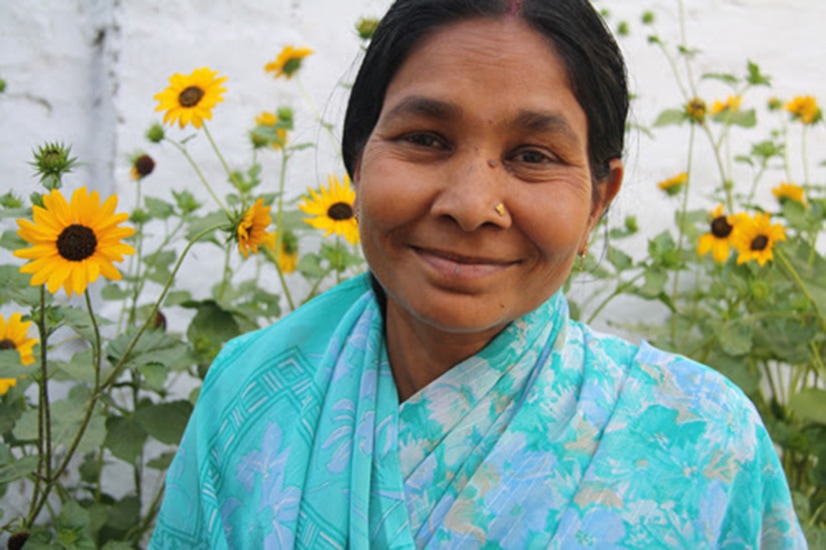
Manju is a farmer, community field worker, and a single mother of 3 from Bihar, one of the poorest states in India. Manju applied to our Women, Food, and Climate Change Training because she was tired of watching her village be ravaged by climate change. As Manju knows all too well, women farmers in India are the backbone of their communities: they are the planters, seed savers, harvesters, water stewards. They do nearly 80% of all farm work, and yet they struggle to own land, and they are the most vulnerable when disasters like floods or droughts strike.
Manju traveled to the Training (hosted by WEA partner Gorakhpur Environmental Action Group) from her village along with 30 other women farmers and rural NGO activists from 4 flood-affected states in Northern India. Manju and the other women shared their first-hand struggles with droughts that had parched their lands and floods that had submerged their farms.
Women learned sustainable agricultural practices, such as mixed farming- – growing diverse food crops on small farms and making natural pesticides and fertilizers using farm inputs. Participants also learned about local and regional campaigns to advance women’s rights as farmers.
Over the course of the year-long training, the women participants saw climate change adaptation farm projects in action. They saw how farmers were building resilience by farming organically, using an integrated farming approach—incorporating livestock and poultry production—to improve their food security; they saw how smokeless chulahs, were not only reducing carbon emissions but were improving the health of women farmers. And they also learned about bio-digestor plants, which used natural inputs of the farm and human soil to generate a cleaner fuel for cooking.
Each team designed action plans and received seed grants to launch their customize farm-based project in their communities. Manju set up her own organic kitchen garden as a demonstration site to show women farmers how they could grow a variety of vegetables right at home even if their farms were flooded. She organized 11 women’s groups, and trained 144 farmers on seed-saving and mixed farming techniques. She hosted trainings, educated women on their rights as farmers and shared information on government programs that women could access to improve their economic and food security.
The WEA Training connected Manju to other participants like Reena, who facilitated the planting of 6,000 indigenous trees in 15 villages and set up 4 farmer clubs to train women on organic farming practices. This network of participants went on to work on advocacy campaigns that promote the rights of women as farmers, taking their leadership from the farm to decision-making arenas. Their work to improve their own financial health and well-being through ecological farming has only just begun. This year-long training of trainers resulted in over 2,050 women farmers trained in practices like seed-saving, organic farming, and other tools that build resilience in the face of climate change.

“My vision is that women in my community stand on their own feet and embrace organic farming practices. I am leading by example to show how this can be achieved,” Manju proudly beamed.
Today, many more farmers are practicing sustainable farming techniques, setting up their own gardens, and saving indigenous seeds thanks to Manju’s action. Now hundreds of people have access to healthy food. From one, she became many.
Over the last ten years, there have been thousands of women like Manju and many inspired into action by women just like her.
Not only are lands healing but women and their families are healing too.