Am I Post-Hope?
By Melinda Kramer, Co-Founder and Co-Executive Director of Women’s Earth Alliance
I recently finished reading Sarah Wilson’s I Eat the Stars, and the book stayed with me long after I closed it. Some nights, it kept me awake.
The world Wilson describes feels painfully close. Extreme heat and drought fueled fires across Europe all summer, forcing people from their homes and stretching firefighters across countries. Lake Powell has fallen to a record low, bringing the Colorado River system even closer to a crisis for the 40 million people who depend on it. Coral reefs, home to a quarter of marine species, have suffered record global bleaching.
I follow environmental news closely because of my work, yet these stories still reach me as a mother, a human being, and someone who loves this planet. I think about the world my children will inherit. I think about the women I know who are already watching familiar rains disappear, crops fail, forests burn, and water sources become less dependable.
Wilson’s book made me feel all of this more intensely. The scale of the unraveling. The exhaustion of trying to absorb one emergency after another. The disorientation of continuing with ordinary life while the foundations of that life feel increasingly precarious.
A question kept returning in the middle of the night:
Am I post-hope?
I Eat the Stars gave me language for a feeling I have carried for years: the crises surrounding us are converging into something larger.
Environmental degradation intensifies inequality. Economic insecurity fuels political instability, and technology keeps accelerating past our capacity to govern it. Each disruption places pressure on the others. Wilson describes this as the collapse of a complex system, an unraveling that is already underway.
For those of us who have spent decades working for the planet, that is a sobering proposition. So much environmental work has been organized around the promise that sufficient effort, funding, and political will can restore a stable future. Wilson asks us to release our attachment to certainty and confront a more unsettling question: How do we live fully and meaningfully when the future feels radically uncertain?
The book’s title comes from "Antidotes to Fear of Death", a poem by the astronomer Rebecca Elson, written as she faced her own death. Eating the stars evokes a ferocious aliveness. When the permanence of the world falls away, beauty becomes more vivid. Love becomes more urgent. The chance to participate in life becomes astonishing.
My question about hope brought me back to Joanna Macy.
Joanna, who died last year, was a dear mentor to me and an advisor to Women’s Earth Alliance. Her thinking has shaped how I understand leadership, grief, and our relationship to the living world. She had a rare ability to face the depth of our planetary crisis while strengthening people’s capacity to act within it.
Wilson calls this period a collapse. Joanna Macy called it the Great Unraveling.
Joanna described three stories unfolding at the same time. Business as Usual is the story of an industrial growth society pursuing extraction, consumption, and expansion. The Great Unraveling is the story of ecological destruction, widening inequality, and the breakdown of the systems on which people depend. The Great Turning is the transition toward a life-sustaining society.
Wilson gives us the courage to look directly at the Great Unraveling. Joanna reminds us that the Great Turning is happening at the same time.
That distinction changed the question for me.
Perhaps I am post-reassurance. I remain deeply committed to Active Hope. The practice is simple to name and hard to live: to keep choosing what I will build without knowing how the story ends.
In Active Hope, Joanna Macy and her co-author Chris Johnstone write, “Active Hope is something we do rather than something we have.” We begin by seeing reality clearly. We identify the direction in which we want the world to move. Then we take our part in moving it there.
Sarah Wilson challenges a form of hope built on reassurance. Joanna Macy offers a hope grounded in participation. Together, their ideas create a powerful invitation: release the demand for guarantees, face the world with honesty, and choose life through the quality of our actions.
Joanna understood grief as evidence of belonging. Our pain for the world reveals our connection to it. When that pain is carried alone, it can harden into despair or exhaustion. When that pain is acknowledged and shared, it can become compassion, and compassion can carry us back into action.
Building Women's Earth Alliance has taught me that collapse is unevenly experienced. For many communities, systemic disruption arrived long ago through colonization, ecosystem destruction, displacement, unreliable public institutions, and recurring economic shocks. Women have often held together the essential systems of daily life through these disruptions. Across these communities, women protect water, preserve seed, feed families, maintain cultural knowledge, and organize people in moments of crisis.
The relationships, knowledge, and local institutions that sustain communities through disruption are essential infrastructure. This infrastructure grows stronger through access to land and resources, practical skills, and sustained support. Women’s leadership becomes transformative when women have genuine agency in shaping community life and our shared future.
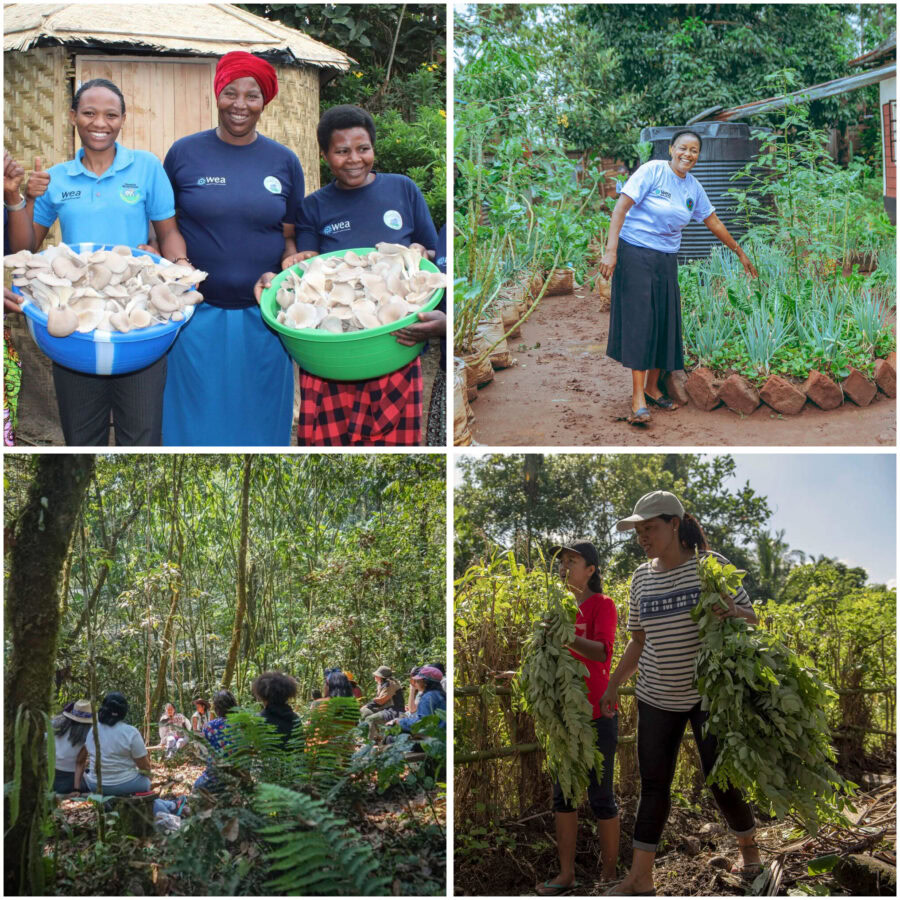
I see it among women in Rwanda turning organic waste into nutritious mushrooms and income, while raising trees that protect soil and reduce pressure on nearby forests. I see it in Kenya, where women are restoring land, growing food, operating tree nurseries, and building livelihoods that can withstand environmental and economic shocks. I see it in Mexico, where women are protecting cloud forests and strengthening community food systems. I see it in Indonesia, where women are restoring peatlands and creating enterprises rooted in the health of local ecosystems.
Against the scale of the unraveling, any one of these efforts can appear small. Together, they show how the Great Turning gathers: through acts of repair, linked across communities and sustained over time.
Across twenty years of Women’s Earth Alliance, I have experienced extraordinary progress alongside devastating loss. I have met women creating solutions of breathtaking intelligence, and I have watched environmental threats intensify around them. I have seen sustained support transform communities, and I have seen how few resources reach the women doing some of the most consequential work on Earth.
Clear seeing asks us to hold all of this.
This is the Great Turning as I have come to know it through WEA. Women defending ecosystems that are still whole. Local economies growing sturdier under their care. And, quietly, a shift in whose knowledge gets listened to when it matters most.
The next chapter of Women's Earth Alliance calls us to stand more fully behind this human and ecological infrastructure. Communities need women with strong networks, control over resources, sustained support, and the freedom to respond as conditions change. This kind of resilience grows over years through relationships that can carry people through circumstances that exceed any project plan.
My own role is becoming clearer too. I want to be a steady node within this larger network, helping people see the truth of this moment without losing contact with their own agency. Mostly I want to move resources toward the women already building what comes next, and to protect the beauty, family, friendship, and contact with the living world that sustain our moral imagination.
Eating the stars becomes a form of devotion and resistance, a way of letting beauty stay visible even now. Joy is what gives us the energy to stay present for it. And love is what keeps expanding the circle of life for which we are willing to act.
The night I finished Wilson’s book, I lay awake thinking of my children and the future moving toward them. I wanted to offer them certainty. What I could offer was my own life, turned toward repair. By morning, the question had settled into a commitment.
We are in the Great Unraveling. We are in the Great Turning too. I am post-reassurance. Hope becomes a practice through what we protect and what we build together. This is how we choose which story receives our lives.
